
The Town Adopts Three New Financial Policies
At the last meeting of its mandate, the municipal council was proud to unanimously adopt three new financial management policies, in support of the Town's ongoing efforts to improve the sound management of its finances.
General Manager Jonathan Fortin presented the three Policies in the charts below (in French only).
Debt Management Policy
This new Policy is seen as an essential tool for controlling the Town’s debt level, ensuring that it does not exceed taxpayers’ ability to pay, while enabling it to increase its debt targets in order to invest in essential maintenance of aging municipal infrastructures.
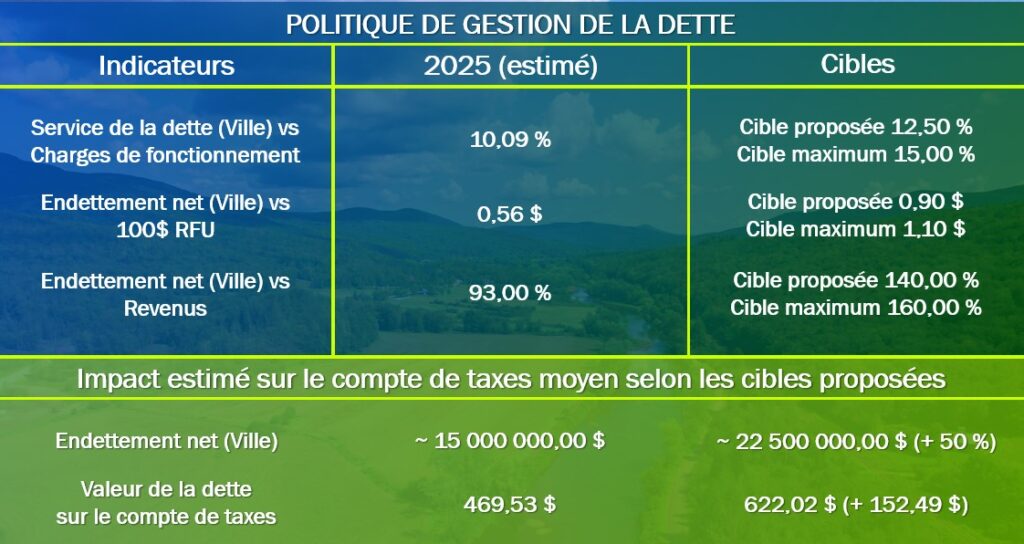
According to this table, a 50% increase in the Town’s net indebtedness would correspond to an increase of $152.49 on the tax bill of a home with an average value of $472,939 (in 2025).
To consult the Debt Management Policy (in French only)
Working Capital Utilization Policy
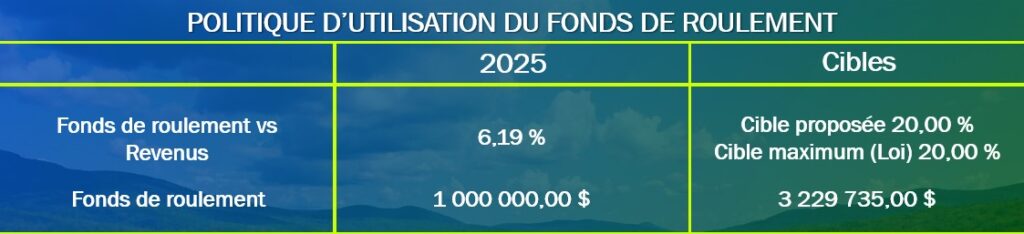
This new Policy is a guide to standardizing the use and repayment of the working capital used to finance municipal infrastructure maintenance.
Working capital is the money the Town sets aside to borrow from itself, without paying interest, unlike a bank loan. The Town’s working capital currently stands at $1 million, or 6.19% of the 2025 budget, whereas the law authorizes it to reach 20%. For projection purposes, if we were to increase the fund to $3.2 million (or 20% of the budget), we would save approximately $1 million in interest over 20 years, which is very advantageous.
To consult the Working Capital Utilization Policy (in French only)
Policy on the Use of Operating Surpluses
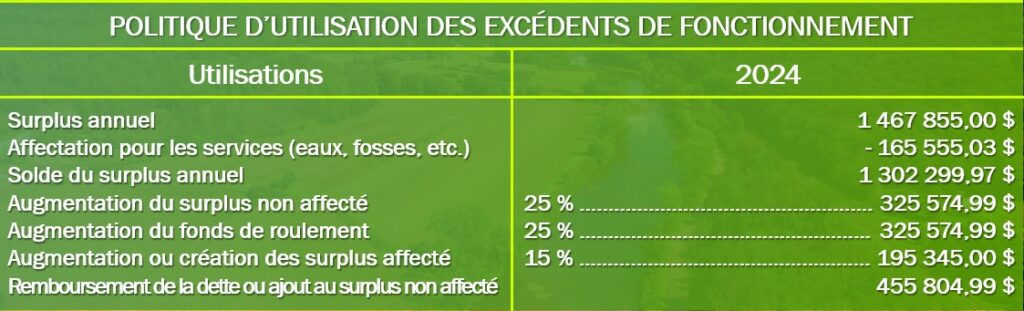
This new Policy aims to provide a framework for the use of operating surpluses, otherwise known as “annual surpluses”.
At the end of each fiscal year, the accumulated surplus is distributed: a portion is always compulsorily allocated to municipal services (water, sewage, collections, etc.). The balance, previously, went entirely into the accumulated surplus (or unalocated surplus). Henceforth, 25% of this balance will go into the unalocated surplus, another 25% into the working capital fund, and another 15% into the affected (or reserved) surplus for special expenses decided by the municipal council (e.g.: fund for the Family and Seniors Policy). The remaining 35% will be used to pay down debt, where possible, or will be added to the unalocated surplus, at Council’s discretion.
To consult the Policy on the Use of Operating Surpluses (in French only)